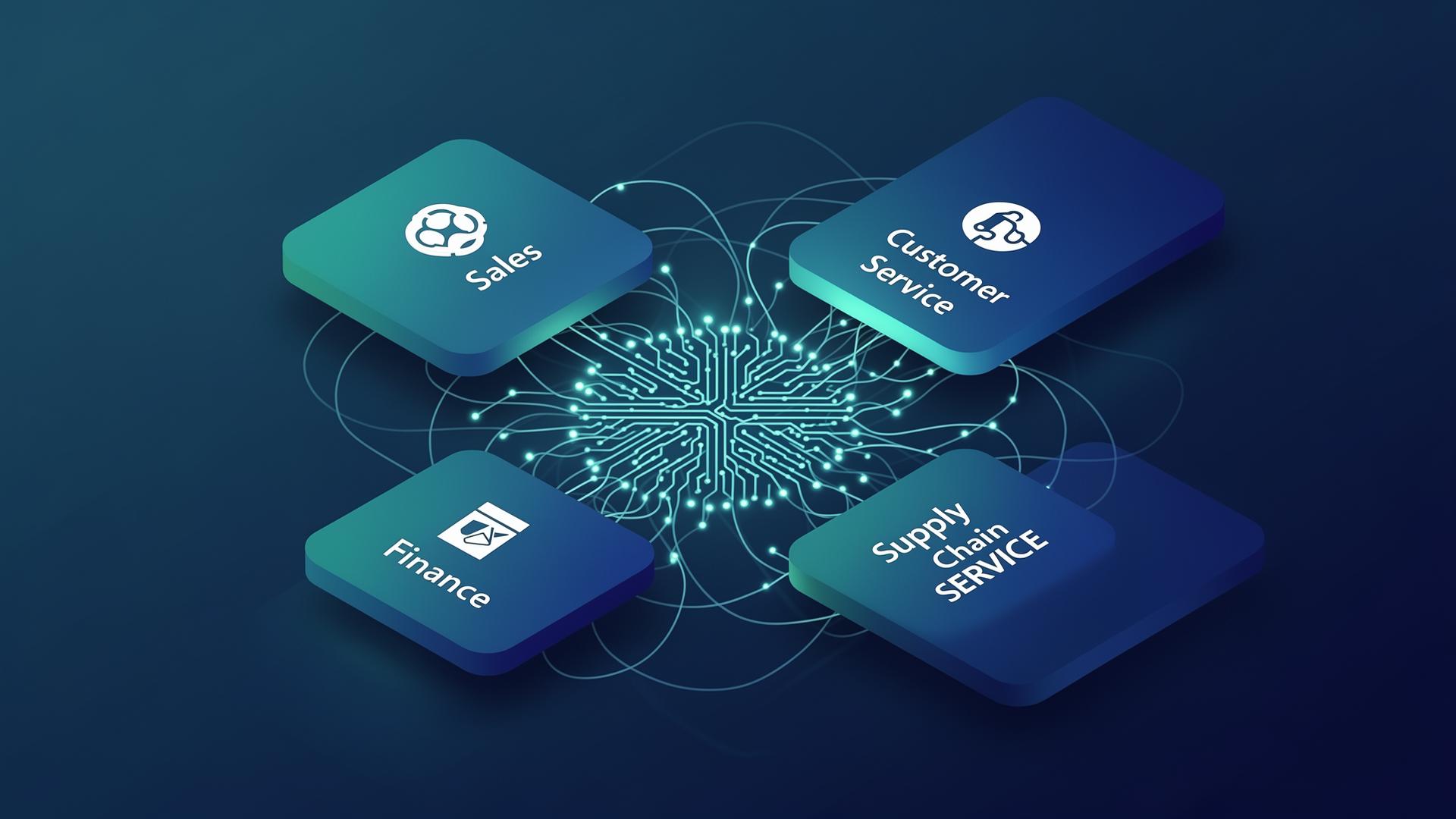
The Dynamics 365 Ecosystem in the AI Era
Dynamics 365 stopped being a set of CRM and ERP modules and started becoming an agent-orchestrated business platform. Here is what that means in practice.
For a decade Dynamics 365 was sold as modules — Sales, Customer Service, Finance, Supply Chain, Field Service. Customers bought one, sometimes two, rarely all five. In the AI era that picture is changing fast: the modules are still there, but the differentiation has moved to Copilot, agents, and the data fabric beneath them.
For a buyer today, the right question is no longer "which Dynamics module do we need?" It is "what agents do we want, on what data, with what guardrails?"
What changed
Every Dynamics 365 app now ships with Copilot — summarizing opportunities in Sales, drafting case responses in Customer Service, explaining variances in Finance, and proposing dispatch in Field Service.
Heavy plug-ins and JavaScript customizations are being replaced by purpose-built agents (Sales Qualification, Customer Intent, Supplier Communications) you can extend in Copilot Studio.
With one-click Dataverse → Fabric mirroring, every Dynamics record is queryable from Fabric notebooks and Power BI in near real time — without ETL.
Power Apps, Power Automate and Pages give every Dynamics process an extensible front end, with the same governance and identity model.
The new map of the ecosystem
Think of Dynamics 365 in 2026 as three layers:
How each module shifts
What to plan for in the next 12 months
If you are running Dynamics 365 today, three plays usually compound the most value:
- Turn on Dataverse → Fabric mirroring and rebuild your operational reporting on OneLake — kill the nightly batch ETL.
- Pick one role (SDR, service agent, planner) and deploy the matching out-of-the-box Dynamics agent before building anything custom.
- Stand up a small Copilot Studio + Foundry pattern for the cross-system use cases the OOB agents can't reach.
Planning a Microsoft AI program?
Talk to AmniZen — Microsoft Solutions Partner for Business Applications and Data & AI. We turn strategy into shipped Copilot, Dynamics 365 and Fabric programs.